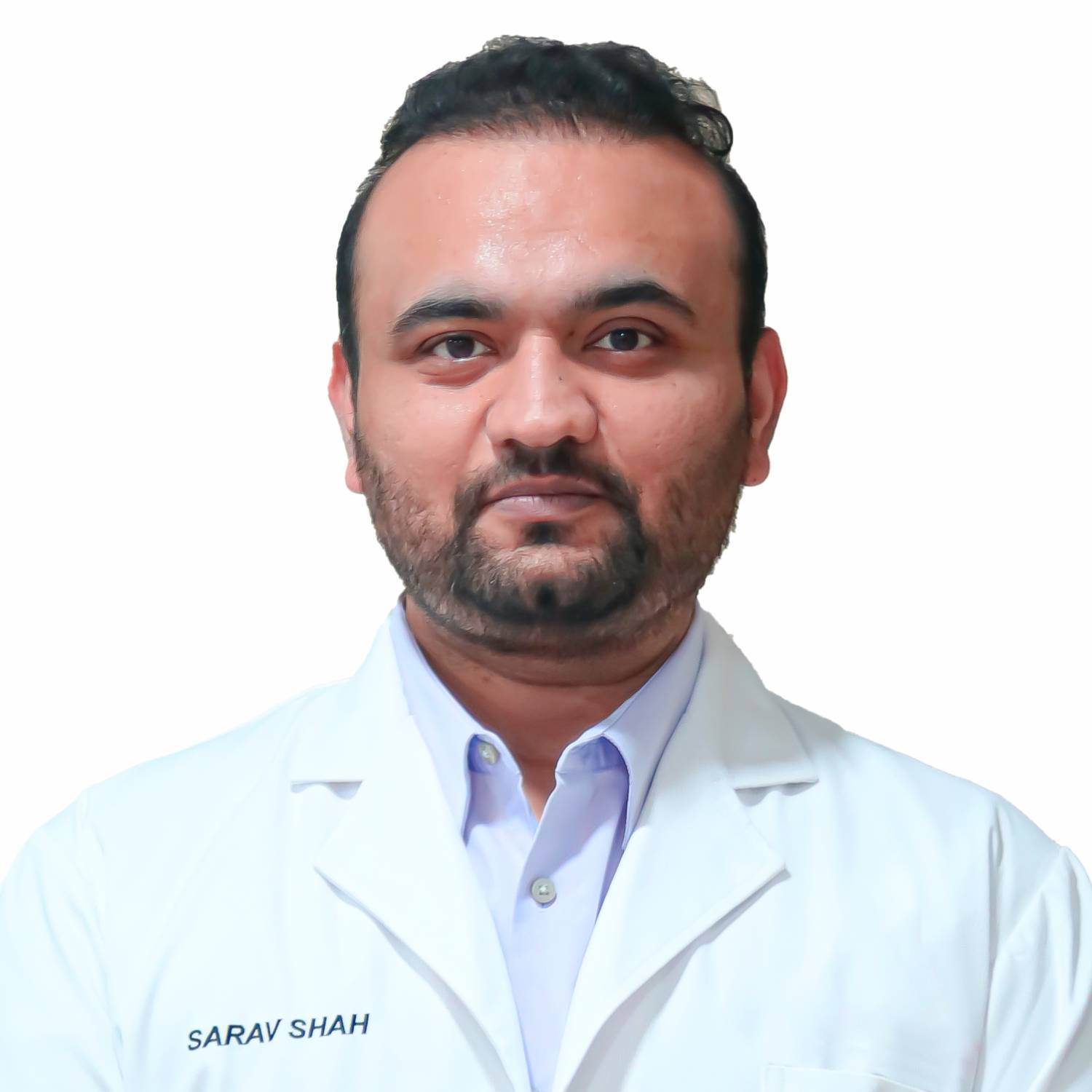
Consultant Dr. Sarav Shah operates on the lungs, the food pipe, the chest wall and the diaphragm, and a large part of his work involves cancers of the chest. His training took him from Baroda to Sir Ganga Ram Hospital in Delhi, then to Civil Hospital in Ahmedabad as an Assistant Professor, and later to Shanghai and New York. Hearing that a scan shows a spot on the lung, or that the food pipe is involved, is one of the hardest moments a family can face, and the questions come all at once. Well-known Cancer Surgeon Sarav Shah in Ahmedabad is a thoracic surgeon by training, which means his focus is cancer of the chest, and he makes a point of explaining the diagnosis, the options, and the reason for each step in plain words.
Qualifications
- MBBS, Baroda Medical College, Vadodara (2016)
- MS (General Surgery), Baroda Medical College, Vadodara (2019)
- DrNB (Thoracic Surgery), Sir Ganga Ram Hospital, New Delhi (2022)
- FICRS (Robotic Surgery), World Laparoscopy Hospital, Gurugram (November 2022)
- Thoracic Surgery training, Tongji University, Shanghai Pulmonary Hospital, Shanghai (June 2024)
- Fellow, Thoracic Surgery Services, Memorial Sloan Kettering, New York, USA (2025)
Areas of Expertise
- Thoracic Surgery
- Thoracic Oncology
- Uniportal VATS (Video-Assisted Thoracoscopic Surgery)
- Uniportal RATS (Robotic-Assisted Thoracoscopic Surgery)
- Lung Transplantation
- Chest Wall Resection and Reconstruction
Professional Memberships
- Indian Society of Thoracic Surgery (ISTS)
- Indian Association of Cardiovascular Thoracic Surgeons (IACTS)
- Society of Respiratory Medicine, Vadodara (SRMV)
Medical Registration Number
G-58201
Where Chest Surgery Meets Cancer Care
A cancer in the chest is usually looked after by a team, with a surgeon, an oncologist, a radiation specialist, a pathologist and a radiologist all taking part. A thoracic surgeon is the member of that team who operates on the lungs, the food pipe and the structures around them. If you have typed Cancer Surgeon near me in Ahmedabad into a search box after a worrying scan, it helps to know that surgery is one option among several, and that the best plan is usually made after the whole team has seen your reports. A good surgeon will tell you honestly whether an operation is the right step for you.
Training in Delhi, Shanghai and New York
After his MBBS and MS at Baroda Medical College, he completed his DrNB in Thoracic Surgery at Sir Ganga Ram Hospital, New Delhi, in 2022. He then worked as an Assistant Professor in the Department of Thoracic and Vascular Surgery at Civil Hospital in Ahmedabad, and trained at the Shanghai Pulmonary Hospital, Tongji University, in 2024. In 2025, he was a fellow in the thoracic surgery services at Memorial Sloan Kettering in New York, a centre known for cancer care. He also holds a fellowship in robotic surgery (FICRS), which is relevant to the robotic chest operations he performs.
What Happens at Your First Appointment
A visit with Dr. Sarav Shah begins with a conversation about your symptoms, how long you have had them, your smoking history, your work, and any family history of cancer. He will examine your chest and review your scans, biopsy reports, and blood tests. Further tests, such as a PET scan, a breathing test or a bronchoscopy, may be needed to plan treatment. Please bring your actual CT or PET films or discs along with the reports, since the images matter, and bring a family member to listen with you.
Chest Symptoms Worth Checking
A cough that lasts more than three weeks, coughing up blood, breathlessness on simple tasks, chest pain that does not settle, a hoarse voice, difficulty swallowing, repeated chest infections, and unexplained weight loss are all worth a proper check. Many have simple causes, but they should not be treated with cough syrups or leftover antibiotics for weeks. An early check gives you more treatment choices.
A Spot on the Lung
A spot or nodule on a scan does not always mean cancer. Old infections, tuberculosis, scars, and harmless growths can look similar. The next step is usually a CT scan, sometimes a PET scan, and often a sample taken through the airways or with a needle. If lung cancer is confirmed, treatment depends on the type and stage, and the surgeon, oncologist, and radiation specialist plan it together. Surgery is an option when the cancer is early enough, and your lungs are strong enough to cope. Ask what the goal of the operation is, what the risks are, and what recovery will look like.
Cancer of the Food Pipe
Oesophageal cancer often begins with food sticking in the throat, painful swallowing, weight loss, chest pain or vomiting, and many people first notice it when solid food becomes hard to swallow. Do not ignore swallowing trouble that lasts more than a couple of weeks. Diagnosis usually involves an endoscopy with a biopsy and a scan. Treatment may combine chemotherapy, radiation, and surgery, and the plan is made by a team. Nutrition matters a great deal during treatment, so ask for a dietitian early.
Mesothelioma and Cancers of the Chest Lining
Mesothelioma is a rare cancer of the thin lining around the lung, and it is linked in many cases to past exposure to asbestos. It may cause breathlessness, chest pain, and fluid around the lung. It can take decades to appear after exposure, so tell your doctor if you have worked with asbestos, in mines, in construction or in shipyards. Diagnosis needs a sample of the lining, and treatment depends on how far the disease has spread.
Keyhole Surgery for the Chest
In video-assisted thoracoscopic surgery (VATS), the surgeon works through small openings in the chest wall using a camera and fine instruments, instead of one large cut. In the uniportal technique, a single small opening is used. For suitable problems, this can mean less pain, a smaller scar, a shorter hospital stay and a quicker return to normal life. It is used to take samples, treat fluid or infection around the lung, and remove part of a lung. It is not right for every patient, and sometimes open surgery is safer, so your surgeon will explain which approach suits you.
Robotic Surgery for the Chest
In robotic-assisted thoracoscopic surgery (RATS), the surgeon sits at a console and controls fine instruments and a three-dimensional camera inside the chest. The robot does not act on its own. The surgeon makes every move. It can help to work in tight spaces and to handle delicate structures. Whether it suits you depends on your condition, your scans and your general health, so ask about the benefits, the risks and the alternatives, and whether it offers an advantage in your case.
Pus and Air Around the Lung
Empyema is a collection of pus in the space around the lung, and it often follows pneumonia. It causes fever, chest pain and breathlessness, and sometimes needs drainage or an operation to clean the space and let the lung expand again. A pneumothorax is air that leaks into the space around the lung and makes it collapse, causing sudden sharp chest pain and breathlessness. Small leaks may settle by themselves, while larger or repeated ones need a tube or surgery. A collapsed lung is an emergency if breathlessness is severe.
When the Lungs Are Damaged
Long-standing lung disease can leave behind damaged areas that cause problems on their own. Bullae are large air-filled spaces in the lung, often linked to COPD, which can press on healthy lung. Bronchiectasis is damage to the airways that leads to a long-term cough with mucus and repeated infections. An aspergilloma is a fungal ball that forms in an old cavity, often after tuberculosis, and can cause coughing up blood. Many patients are managed with medicines and physiotherapy, and surgery is considered in selected cases. Do not ignore coughing up blood, however small.
Chest Injuries
Blunt chest injuries from road accidents or falls can break ribs, bruise the lungs, cause bleeding or air around the lung, and damage the diaphragm. Pain with breathing, breathlessness, a bluish colour and swelling under the skin need urgent attention. Many chest injuries are treated with pain control, tubes and physiotherapy, and some need surgery to stabilise the chest wall or stop bleeding. Do not delay going to hospital after a heavy blow to the chest, even if you feel only mild pain.
The Diaphragm
The diaphragm is the large muscle under the lungs that powers breathing. A diaphragmatic hernia happens when abdominal contents push through a gap, causing pain, breathlessness or digestive symptoms. Diaphragmatic palsy means the muscle is weak or paralysed, which can cause breathlessness, especially when lying flat. Both are diagnosed with scans and breathing tests, and surgery is considered when symptoms are troublesome.
Excessive Sweating of the Hands
Hyperhidrosis is excessive sweating that is out of proportion to heat or effort, most often in the palms, armpits or feet, and it can affect work, studies and confidence. Many people improve with antiperspirants, medicines or other treatments. In selected cases with severe sweating of the palms, a keyhole operation on the nerves in the chest may be considered. Ask about the benefits and the risk of increased sweating in other areas of the body afterwards, since this is a known effect.
Lung Transplant and Chest Wall Reconstruction
A lung transplant is considered for people with very severe lung disease who have run out of other options. It needs a full assessment, a suitable donor, a strong support system, and lifelong follow-up. Transplants in India follow a legal process, including approvals and donor allocation rules. Chest wall resection and reconstruction is used to remove tumours or infections from the ribs and chest wall and to rebuild the area. Your surgeon will explain whether either applies to you and what the process involves.
Getting Ready for Chest Surgery
Your doctor will explain why surgery is advised, what the risks are and what the alternatives are. Before the operation, you will have blood tests, scans, a breathing test, an ECG and an anaesthesia assessment. Bring all your earlier reports and a full list of your medicines, especially blood thinners, aspirin and diabetes medicines, since some must be adjusted. Stopping smoking, even a few weeks beforehand, lowers the risk of complications, and breathing exercises and walking help your lungs. Ask every question you have, and ask a family member to be with you when the consent is explained.
Healing and Breathing After Surgery
After chest surgery, you rest in a recovery area or ICU, where your breathing, pain, and drains are watched closely. A tube may be placed in the chest for a short time to drain fluid and air. Breathing exercises, coughing with support and early walking are an important part of recovery and lower the risk of chest infections. You will be told about wound care, medicines, activity and when to return to work. If you were treated by Dr. Sarav Shah, keep every follow-up visit, since reports and further treatment are discussed then.
Consulting From a Distance
Teleconsultation is available with Dr. Sarav Shah. It can be useful for follow-up, reviewing scans and reports, and getting an initial opinion before travelling. A video or phone consultation cannot replace an examination or a procedure, and he may ask you to come in person. Please keep your scans, reports and medicine list ready before the call.
Chest Warning Signs That Cannot Wait
Go to the nearest emergency department straight away for severe breathlessness, sudden sharp chest pain, coughing up a large amount of blood, a blue or grey colour of the lips, or a heavy blow to the chest with pain on breathing. After surgery, contact the team promptly for increasing breathlessness, fever, redness or discharge from a wound, a drain that stops working, chest pain, or pain and swelling in the calf. Do not wait for an OPD day.
Booking an Appointment
To book a consultation with Dr. Sarav Shah at Marengo Asia Hospital in Ahmedabad, visit during OPD hours from Monday to Friday, 10:00 am to 5:00 pm. Please bring your CT or PET scan films or discs, biopsy and blood reports, discharge summaries and prescriptions, along with a list of all the medicines and supplements you take.