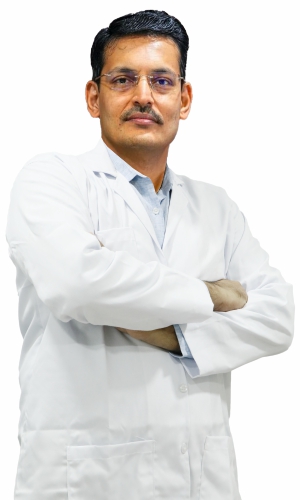
Consultant Dr. Prathmesh Jain treats the knees and shoulders of people who play sports, people who used to, and people who simply want to climb stairs, lift a child, or reach a shelf without pain. A twisted knee on the football ground or a shoulder that suddenly will not lift can bring life to a halt, and the first question is always what happens next. Experienced Orthopedic Doctor Prathmesh Jain in Ahmedabad works at Marengo Asia Hospital, and he focuses on explaining the injury, what the scan shows, and which treatment is likely to help, in plain words, before any decision is made.
Qualifications
- Fellowship in Arthroscopy (USA)
- MS (Orthopaedics), AIIMS, New Delhi (2004)
- MBBS, AIIMS, New Delhi (1998)
Areas of Expertise
- Knee Arthroscopy
- Shoulder Arthroscopy
- Knee Injuries, including Ligament Tears and Meniscus Tears
- Shoulder Injuries, including Frozen Shoulder, Shoulder Dislocation and Rotator Cuff Injuries
- Knee and Shoulder Replacement
- Management of Orthopaedic Complications
- Sports Injury Treatment and Sports Medicine
Professional Memberships
- Indian Orthopaedic Association
- Indian Medical Association (IMA)
- Indian Arthroscopy Society
- Arthroscopy Society of North America
When the Pain Will Not Go Away
Joint pain is easy to live with for months, telling yourself it will pass. A knee that clicks or gives way, a shoulder that aches at night, or a joint that swells after activity usually needs more than another painkiller. If you have been typing Orthopedic Doctor near me in Ahmedabad because a knee or shoulder problem is slowing you down, the most useful step is a proper examination and the right scan. Many problems improve without surgery, and an operation is advised only when it is likely to help.
Your First Visit
A consultation with Dr. Prathmesh Jain begins with a conversation about how the problem started, what you were doing at the time, what makes it better or worse, earlier injuries, your work, and your sport. He will examine the joint, checking movement, strength, and stability, and review your X-rays or MRI. Bring the actual films or discs along with the reports, since the images matter. Tell him what you want to get back to, whether it is a game of cricket or a walk to the market, because that shapes the plan.
Keyhole Surgery for Joints
Arthroscopy uses a tiny camera and fine instruments through small cuts to look inside a joint and treat the problem at the same time. Because the cuts are small, the pain is often less and recovery quicker than with open surgery, though not every problem can be treated this way. It is commonly used in the knee and the shoulder. Your surgeon will tell you honestly whether arthroscopy suits your condition or whether another approach is better.
Torn Ligaments and Knee Injuries
A sudden twist of the knee, a landing from a jump or a tackle can tear the ligaments that hold the knee steady, most often the anterior cruciate ligament (ACL). A popping sound, quick swelling and a feeling of the knee giving way are common signs. Rest, ice, a compression bandage, and raising the leg help in the first days, but the injury should be examined and scanned. Some partial tears heal with physiotherapy, while a complete tear in an active person is often repaired. Returning to sport too early risks damaging the knee further.
Meniscus Tears
The menisci are two cushions of cartilage inside the knee. They can tear in a sudden twist, or wear thin gradually with age. Pain along the joint line, swelling, catching or locking of the knee and difficulty fully straightening it are typical signs. Small tears may settle with rest, exercise and medicines, while others, especially those that lock the knee, may need keyhole surgery to repair or trim the damaged part. Saving the meniscus where possible helps to protect the knee in later years.
Shoulder Pain and the Rotator Cuff
The rotator cuff is a group of tendons that keeps the shoulder joint steady and lets you lift your arm. Tears can follow a fall or heavy lifting, or build up slowly with age and overuse. Signs include pain when lifting the arm, night pain, weakness, and difficulty reaching overhead. Many partial tears improve with exercises and medicines, while others need repair. Bio-inductive implants, such as the REGENETEN implant, can be used in selected patients to support healing of the tendon, and your surgeon will explain whether this is suitable for you, along with its benefits and limits.
Frozen Shoulder and Shoulder Dislocation
A frozen shoulder becomes painful and stiff, often in stages over many months, and it is more common in people with diabetes. Gentle stretches, physiotherapy, medicines and sometimes injections help most people, and surgery is rarely needed. A dislocated shoulder, in which the ball slips out of the socket, needs prompt medical care. If it keeps happening, the joint may need surgery to make it stable. Do not try to push a dislocated shoulder back yourself, and keep the arm supported until you are seen.
Sports Injuries and Getting Back to the Game
Sprains, strains, tendon injuries, ligament tears, and overuse problems are part of an active life. Warm up, build strength, use the right shoes and equipment, and increase training gradually to lower the risk. After an injury, rest and treatment come first, then rehabilitation to restore movement, strength, and balance, and finally a gradual return to sport. Rushing back is the most common reason for a second injury. A sports medicine approach plans each stage, so you return to play safely, whether you are a professional or a weekend player.
When a Joint Needs Replacing
Arthritis can wear away the cartilage in the knee or shoulder, leaving bone rubbing on bone, with constant pain, stiffness and difficulty with everyday tasks. Walking aids, exercise, weight control, medicines and injections help many people for a long time. When these are no longer enough, joint replacement may be considered, in which the damaged surfaces are replaced with implants. It is a major operation with real risks, and it is advised only after careful assessment. Ask about the benefits, the risks, how long implants last, and what recovery will involve.
When an Earlier Operation Has Not Gone Well
Sometimes a joint remains painful, stiff or unstable after an earlier surgery, or an implant loosens or becomes infected. These situations need careful assessment, usually with new scans and a review of the earlier operation notes. Bring every report, X-ray and discharge summary from the earlier surgery. Treatment may involve rehabilitation, further surgery or revision of an implant, and the plan is explained step by step.
Preparing for Surgery
Your doctor will explain why surgery is advised, what it involves, what the risks are, and how long recovery will take. Before the operation, you will usually have blood tests, X-rays and a general health check, and the anaesthesia team will assess you. Bring all your earlier reports and a full list of your medicines, especially blood thinners, aspirin and diabetes medicines, since some may need to be adjusted. Keeping your weight, blood sugar and blood pressure under control helps. Plan ahead for help at home and time off work.
Rehabilitation and Recovery
Physiotherapy is a vital part of recovery after arthroscopy or joint replacement, and it often begins early. You will be shown how to use a sling, crutches, or a brace, how to care for the wound, and which movements to avoid in the early weeks. Take your medicines as prescribed, do your exercises regularly, and attend every follow-up visit. If Dr. Prathmesh Jain treated you, bring your questions and exercise log to each visit, since the plan is adjusted as you improve.
Warning Signs That Cannot Wait
Go to the nearest emergency department straight away after an injury with severe pain, a visibly deformed joint, an open wound, or if you cannot move or put weight on the limb. After surgery, contact the team promptly for worsening pain, fever, redness or discharge from the wound, a limb that feels cold, numb, or pale, pain or swelling in the calf, breathlessness, or chest pain. Do not wait for an OPD day.
Booking an Appointment
To book a consultation with Dr. Prathmesh Jain at Marengo Asia Hospital in Ahmedabad, visit during OPD hours from Monday to Friday, 10:00 am to 5:00 pm. Please bring your earlier X-rays, MRI films or discs, reports, and prescriptions, along with a list of all the medicines and supplements you take.