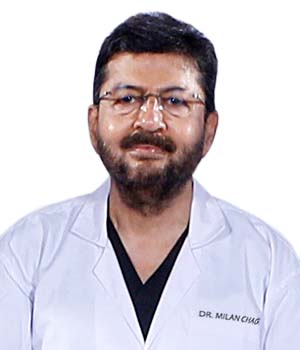
Dr. Milan Chag is a Heart Specialist in Ahmedabad with 30 years of dedicated work in cardiology. At Marengo Asia Hospital, he treats blocked heart arteries, diseases of the aorta, valve problems, heart failure, cardiomyopathy, and congenital and structural heart disease, using catheter-based techniques wherever possible. His practice also includes advanced heart failure care, from medicines to left ventricular assist devices (LVAD) and heart transplant. If you are looking for Heart Specialist Dr. Milan Chag in Ahmedabad, you will find a cardiologist whose work spans everyday coronary care and some of the most complex procedures in modern cardiology. He has been awarded a Fellowship of the American College of Cardiology and is a writing committee member for a national consensus statement on dyslipidaemia.
Qualifications and Fellowships
- FACC: Fellowship of the American College of Cardiology, awarded in 2014
Areas of Expertise
Coronary Interventions
Dr. Milan Chag performs coronary interventions, including the use of intravascular imaging (IVUS and OCT) and intravascular physiology (FFR and RFR). These tools help a cardiologist see inside a blocked artery and measure how much it is limiting blood flow, so treatment can be targeted to the blockages that matter.
Non-Coronary Interventions for Aortic Disease
His work includes EVAR and TEVAR, which are catheter-based repairs of aneurysms and other diseases of the aorta, the body’s main artery.
Transcatheter Valve Procedures
His profile lists these among his areas of leadership:
- Transcatheter aortic valve implantation (TAVI or TAVR)
- Transcatheter valve-in-valve mitral valve implant
- Device closure of paravalvular leaks
Congenital and Structural Heart Disease
He performs interventions for congenital and structural heart disease, treating many heart defects through catheters instead of open surgery.
Heart Failure, LVAD and Heart Transplant
His heart failure work covers medical therapy, left ventricular assist devices (LVAD), mechanical circulatory support (MCS), and heart transplant.
Myocarditis and Cardiomyopathy
He manages myocarditis and cardiomyopathy, including septal reduction therapy (PTSMA or ASA) for hypertrophic obstructive cardiomyopathy.
Awards and Recognition
- Fellowship of the American College of Cardiology (FACC), 2014
- Distinguished Service Award in Cardiovascular Science, Medicine and Surgery: International Academy of Cardiovascular Sciences, Winnipeg, Canada (February 2011)
- Certified Solo Implanter for TAVI with the Evolut platform, certified by Dr. Geza Fontos, Chief of Interventional Cardiology, Hungary
Research and Academic Contributions
Dr. Milan Chag was a writing committee member for the Expert Consensus Statement on Management of Dyslipidemia in Indians 2016, Parts 1 and 2. Consensus statements like this guide how doctors across the country manage cholesterol and related risks.
Leadership in Structural and Interventional Cardiology
His profile describes him as a pioneer in coronary interventions with intravascular imaging and physiology, non-coronary aortic interventions, and transcatheter valve procedures including TAVI, valve-in-valve mitral implantation, and paravalvular leak closure. These are areas where a procedure’s success depends heavily on the operator’s experience, which is why long, focused practice matters.
What Does an Interventional Cardiologist Do?
An interventional cardiologist is a heart specialist trained to diagnose and treat heart disease through thin tubes (catheters) passed into blood vessels, without open-heart surgery. These procedures include angiography to see the arteries, angioplasty and stenting to open blockages, and newer techniques to repair valves and the aorta. Many patients recover faster than after open surgery, although the right treatment always depends on the individual.
Coronary Angioplasty and Intravascular Imaging
In angioplasty, a doctor guides a catheter to a narrowed artery, widens it with a balloon, and usually places a stent to keep it open. Intravascular imaging, such as IVUS and OCT, uses a tiny probe inside the artery to show the vessel wall and the stent from within. This can help the doctor choose the right stent size and check that it is well placed.
FFR and RFR: Measuring How Serious a Blockage Is
A blockage can look severe on an angiogram without actually limiting blood flow much. Intravascular physiology tests, such as FFR and RFR, measure the pressure across the narrowing to show whether it needs treatment. This helps avoid unnecessary stents and ensures that important blockages are treated.
Aortic Aneurysm Repair: EVAR and TEVAR
An aortic aneurysm is a bulge in the wall of the aorta that can be dangerous if it grows or bursts. In EVAR (endovascular aneurysm repair) for the abdomen and TEVAR (thoracic endovascular aortic repair) for the chest, a stent graft is placed through the blood vessels to strengthen the weak area, often without a large incision. Suitability depends on the shape of the aorta, and your doctor will assess this with scans.
TAVI: Replacing the Aortic Valve Without Open-Heart Surgery
In severe aortic stenosis, the aortic valve becomes narrow, and the heart must work harder. TAVI (also called TAVR) replaces the valve through a catheter, usually from the groin, without opening the chest. It is widely used for patients who are elderly or at higher surgical risk, and in some patients at lower risk too. Your heart team will decide whether TAVI or surgery is the better choice for you.
Valve-in-Valve Procedures and Paravalvular Leaks
When an artificial heart valve wears out, a new valve can sometimes be placed inside it through a catheter, which is called a valve-in-valve procedure. A paravalvular leak is a gap around a previously placed valve, and it can sometimes be closed with a small device passed through a catheter. These procedures can spare patients a repeat open-heart operation.
Heart Failure: Medicines, Devices and Transplant
Heart failure means the heart cannot pump blood as well as the body needs. Treatment usually starts with medicines and lifestyle changes, and some patients benefit from devices. When the heart is severely weakened, options may include an LVAD, which helps the heart pump, or a heart transplant. Each patient needs a careful assessment by a specialised team, and early referral gives the most options.
Cardiomyopathy and Hypertrophic Obstructive Cardiomyopathy
Cardiomyopathy is a disease of the heart muscle. In hypertrophic obstructive cardiomyopathy (HOCM), the muscle between the heart’s chambers is abnormally thick and can block blood flow. When medicines are not enough, septal reduction therapy, such as alcohol septal ablation (ASA, also called PTSMA), thins the thickened muscle through a catheter. Which treatment is right depends on your symptoms and tests.
Myocarditis: Inflammation of the Heart Muscle
Myocarditis is inflammation of the heart muscle, often after an infection. It can cause chest pain, breathlessness, palpitations, or tiredness, and ranges from mild to severe. Careful assessment and follow-up are needed, and your doctor may advise rest from strenuous activity while the heart recovers.
Cholesterol and Heart Health
High cholesterol and related fats in the blood raise the risk of heart attack and stroke, and Indians often face a particular pattern of risk. A healthy diet, regular exercise, not smoking, and medicines when needed all help. If you have heart disease, diabetes, or a strong family history, ask your doctor about regular lipid testing and the targets that suit you.
Warning Signs of a Heart Attack
Seek emergency care immediately if you or someone near you has:
- Chest pain, pressure or tightness, especially lasting more than a few minutes
- Pain spreading to the arm, shoulder, neck, jaw or back
- Sweating, nausea or sudden breathlessness
- Light-headedness or fainting
Women, older adults and people with diabetes may have less typical symptoms, such as unusual tiredness, nausea or discomfort in the upper abdomen. Do not drive yourself to the hospital.
Symptoms That Need a Heart Specialist’s Attention
See a doctor if you notice:
- Chest discomfort during exertion that eases with rest
- Breathlessness on mild effort or when lying down
- Swelling in the legs or ankles
- Palpitations or an irregular heartbeat
- Fainting, dizziness or unexplained tiredness
Preparing for Your Cardiology Consultation
Bring your ECG, echo, angiography and other reports, along with a list of your current medicines. Note when your symptoms began, what triggers them, and whether anyone in your family has had heart disease. If you are seeking a second opinion on a procedure such as TAVI, bring your scans and the doctor’s recommendation. These details help your cardiologist reach a clear plan sooner.
Meet Dr. Milan Chag at Marengo Asia Hospital in Ahmedabad
If you have been told you need an angioplasty, valve procedure, aortic repair, LVAD, or heart transplant evaluation, or you want a second opinion on a heart condition, you can consult Dr. Milan Chag at Marengo Asia Hospital in Ahmedabad. His OPD runs on Monday, Wednesday, and Friday, 9:00 AM to 5:00 PM.