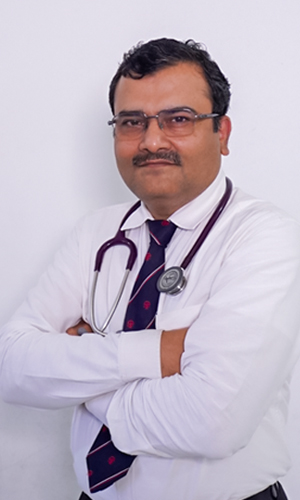
Dr. Anuj Maheshbhai Clerk | Critical Care Specialist in Surat
Dr. Anuj Maheshbhai Clerk is a senior critical care physician with more than 28 years of experience, practising at Marengo Asia Hospitals in Surat. He holds an MBBS, an MD in General Medicine, and a range of critical care qualifications. His expertise covers advanced haemodynamics, mechanical ventilation, critical care ultrasound and resuscitation, with a strong emphasis on error prevention and safe practice.
Qualifications
- FNB (Critical Care Medicine)
- European Diploma in Critical Care Medicine (EDIC)
- IDCCM
- Fellow, CCEF
- MD (General Medicine)
- MBBS
Areas of Expertise
- Advanced Haemodynamics and Mechanical Ventilation
- Point-of-Care and Critical Care Ultrasound
- Resuscitation, including CPR and Post-ROSC Care
- Error Prevention in Clinical Practice
- Counselling
- Professional Training and Education
Research, Publications & Academic Contributions
- Teacher for IDCCM, FCCU and FCCE courses of the Indian College of Critical Care Medicine
- More than 60 publications
- 21 book chapters
Resuscitation and CPR: What Every Family Should Know
If someone collapses and is unresponsive and not breathing normally, call for emergency help at once and start chest compressions. Place the heel of one hand on the centre of the chest, put the other hand on top, and push hard and fast, at about 100 to 120 compressions a minute, letting the chest rise fully between pushes. Untrained bystanders can use compressions alone. Continue until help arrives or the person recovers. Quick CPR can double or triple the chance of survival, and learning it takes only a few hours.
After the Heart Restarts: Post-ROSC Care
ROSC means return of spontaneous circulation, when the heartbeat comes back after cardiac arrest. This is the start of recovery, not the end of treatment. Patients need close monitoring in intensive care, support for breathing and blood pressure, a search for the cause of the arrest, and care to protect the brain and other organs. Recovery varies, and the team will discuss what is happening, what to expect, and what the next steps are with the family.
Haemodynamics and Ventilation: Supporting Breathing and Circulation
Haemodynamics describes how blood flows through the body and how well it delivers oxygen to the organs. In very sick patients, the intensive care team measures blood pressure, heart function and fluid balance, and adjusts fluids and medicines to match. When the lungs are failing, a ventilator supports or replaces breathing while the underlying illness is treated. Settings are adjusted constantly, and the team works to reduce the time on a ventilator as soon as it is safe.
Ultrasound at the Bedside
Point-of-care ultrasound is a scan done at the bedside by the treating doctor. In intensive care, it gives a quick look at the heart, lungs, blood vessels and abdomen, helping the team find the cause of low blood pressure, breathlessness or collapse and guide treatment without moving a critically ill patient. It does not use radiation, and it can be repeated as often as needed. It supports, but does not replace, the doctor's examination and other tests.
Safe Care in the ICU: Preventing Errors
Intensive care involves many medicines, devices, and decisions every hour, so safety depends on systems as much as on skill. Checklists, clear handovers, double-checks on medicines, infection control, and open communication between doctors and nurses all reduce the chance of error. Families can help by asking questions, sharing the patient's medical history and allergies, and speaking up if something seems wrong.
Choosing a Critical Care Specialist in Surat
When a loved one is critically ill, families often start by searching for the Best Critical Care Specialist Dr. Anuj Maheshbhai Clerk in Surat or the Top Critical Care Specialist in Surat. It's a natural reaction, because in those moments you want the most capable person looking after someone you love.
The truth is that great intensive care isn't about rankings or labels. It comes down to how well the doctor is trained, how experienced the full team is (nurses, respiratory therapists, and junior doctors all matter), and what equipment the hospital has on hand.
Supporting a Family Member in Intensive Care
Having a loved one in intensive care is stressful. The team will explain the diagnosis, the treatment, and what to expect, and you should feel free to ask for updates in plain language. Follow the guidance on visiting hours and hygiene, look after your own rest and meals, and share the load with other family members. Keep one family member as the main point of contact, so that information stays clear and consistent.
Consultations With Dr. Anuj Maheshbhai Clerk
OPD consultations are held on Mondays, Tuesdays, Wednesdays, and Fridays, from 3:00 PM to 7:00 PM. To arrange a visit with Dr. Anuj Maheshbhai Clerk, contact us in advance and bring earlier reports, scans, and prescriptions.